Most of the words are written by AI, and every figure is drawn by AI as code. People decide what each chapter teaches and read every draft.
How we write →Getting your child educated rests on a book, a school and, for many families, coaching.
Each one leaves something out. Manthika makes those missing parts: CBSE textbooks on the syllabus for Classes 6 to 12, lessons that check every answer, a book on how to study, and a feed for the phone.
Where each one falls short
The book
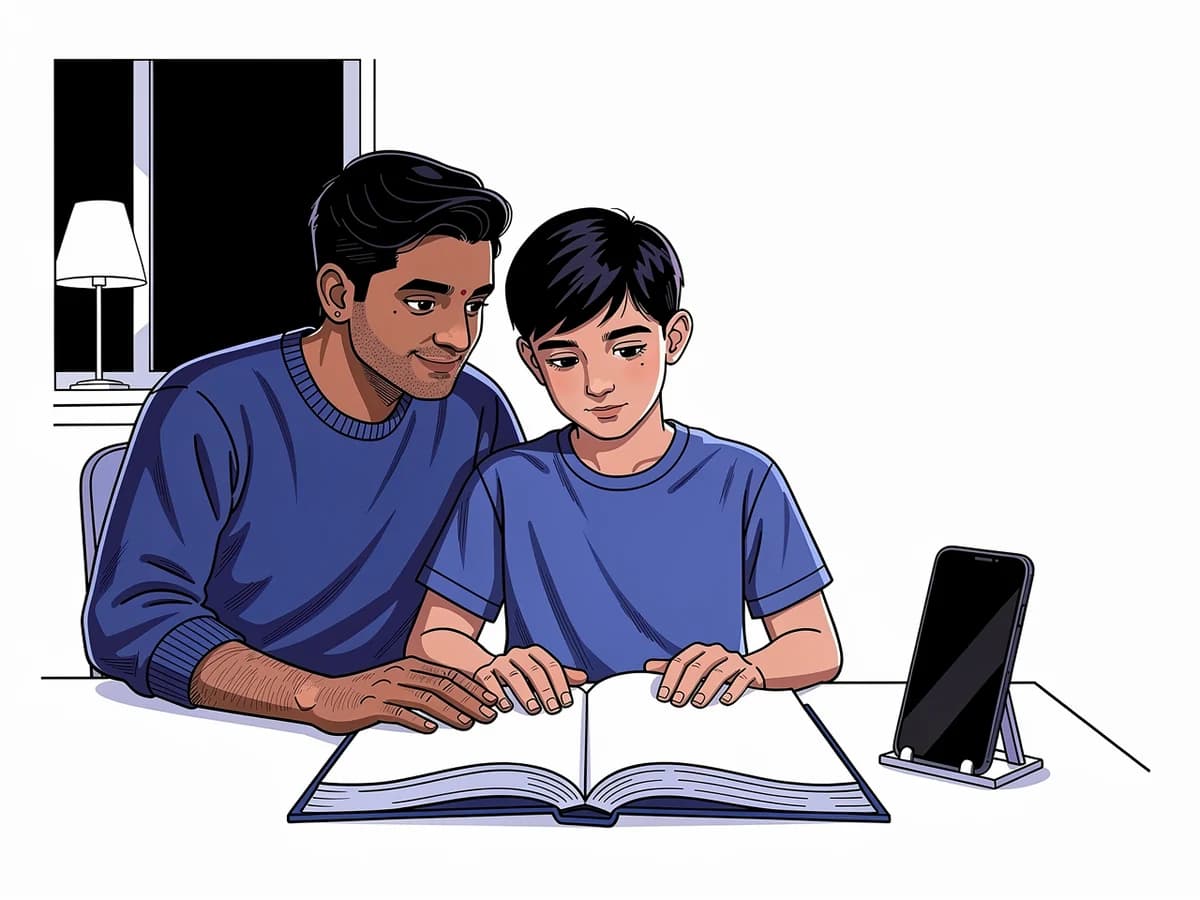
A textbook is written for an average child, and for a classroom with a teacher in it. It gives the rule and leaves the reason to the teacher. Families buy a guide book to sit beside it.
The school
One teacher has a large class. Every child is ahead in some topics and behind in others, and one teacher cannot follow each of them.
In rural India in 2022, 42.8% of Class 5 children could read a Class 2 text. ASER 2022
Coaching
Families pay for coaching when the book and the school have not been enough. It costs money, and it takes the child’s evenings.
About one in five students paid for private coaching in 2017-18, and close to one in three at the secondary stage. National Sample Survey, 75th round
How Manthika fixes each one
The bookThe textbook
The reason sits beside the rule, so the explaining is on the page. It is on the CBSE syllabus and in the language a child reads.
The schoolThe lessonsThey follow one child at a time, check every answer, and point a wrong answer back to the earlier idea it depends on.
CoachingThe two together
The textbook explains and the lessons check every answer. Both are in one place, and the first chapter is free.
Two more things none of the three cover, and Manthika makes something for each.
Nobody teaches a child how to study
Children are told to study and left to work out how. Most reread and highlight. Of the ten techniques researchers compared, those two are among the least useful, and testing yourself and spreading revision over days are the two best.
Dunlosky and others, 2013
How to studySpare minutes go to the phone
Opening a book takes a decision, and ten spare minutes rarely produce one. The phone is already in the hand.
The FeedYour child studies for hours, and the results do not show it.
How to study is a skill, and no subject teaches it. ManthikaOS is a shelf of six short books that do: how to study, how to express, how to find out, how to reason, how to decide, and how to hold your attention.
The first chapter of How to Study, Reading to learn, is free to read today. The rest of the shelf is still being written.
Ten free minutes on the phone can go to learning.
The Feed is the same ideas as small cards. Opening it takes no decision.
- A card opens an idea the child has not met yet.
- A card returns to one read in the last day.
- A card returns to an older one, the least recently read first.
How it is done
Why this was hard to make before
Knowing a subject and writing it for a child are two different skills. Few people have both.
A book written this way has always been expensive to make, and a revision used to take months.
AI writes our drafts and AI reviewers criticise them, so a revision takes hours. People decide what to teach, in what order and how it should sound, and read everything that ships.
A good teacher with one child does four things.
Manthika makes one thing for each.
What is in our textbook
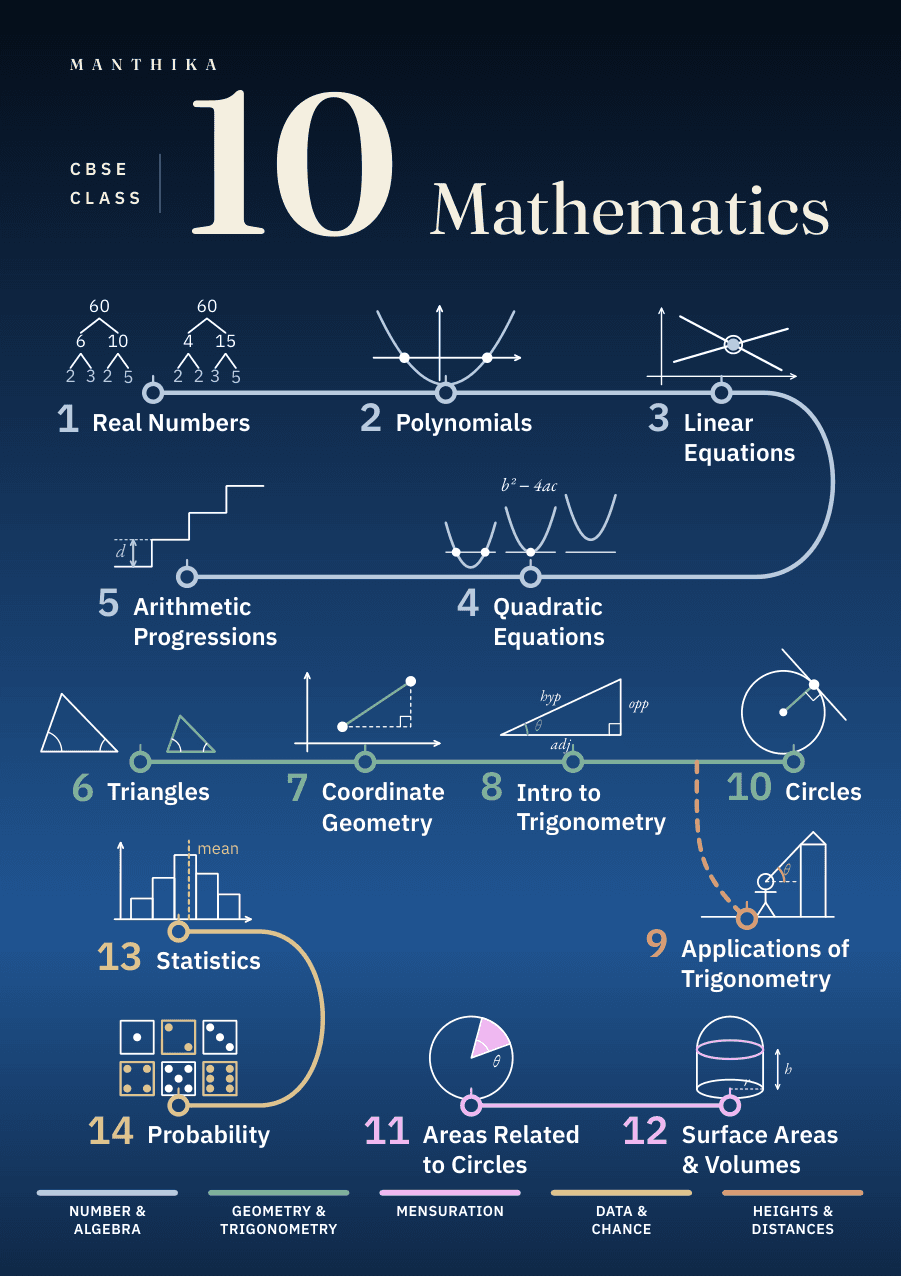
Every chapter of Class 10 Mathematics has these.
- A story opens the chapter and poses the problem before any rule is named.
- Before you start: what the chapter needs from Classes 8 and 9, each with a one-line check.
- A margin rail beside the text: the rule, the one fact to remember, the error at that step, a quick question, and the earlier idea it depends on.
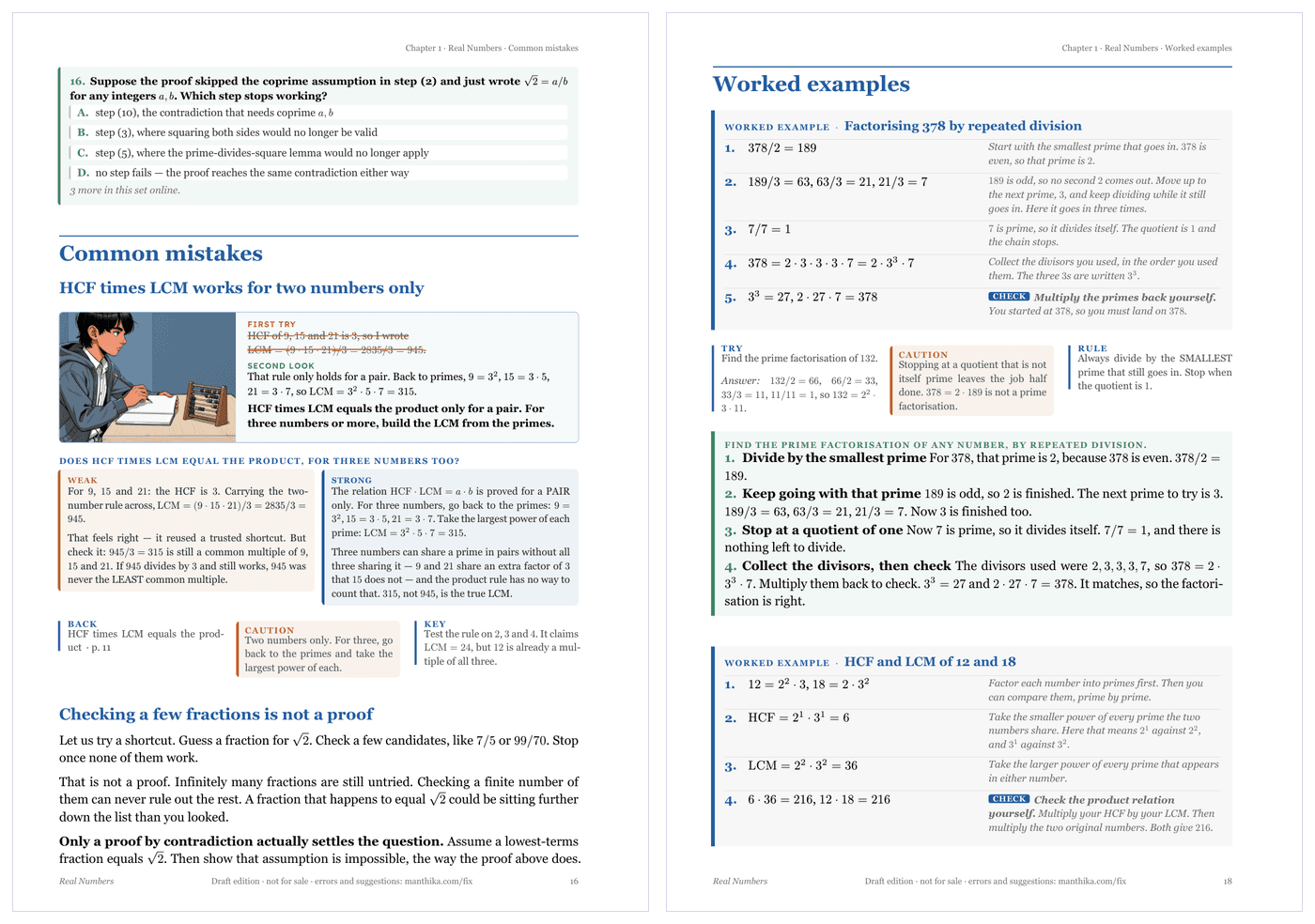
- First try, second look: a likely wrong attempt, then the fix, naming where it went wrong.
- Every worked example gives the reason beside each line.
- Every practice set solves its first problem in full. Answers to the rest are printed under the set.
HCF and LCM
The usual way
It is usually a rule to memorise: HCF × LCM equals the product of the two numbers. For 8 and 12, 4 × 24 = 8 × 12.
Our way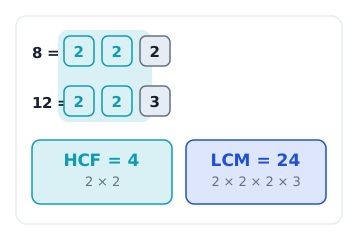
Write 8 and 12 as prime factors. Between them, HCF and LCM use each of the six factors once, so HCF × LCM equals 8 × 12.
14 chapters · 14 topics · 879 auto-graded questions · See all chapters and topics
How the lessons work
Here is what the lessons do.
- A short starting check, then a short lesson before the first new question.
- Every answer is graded on the spot, with the reason for a wrong one and a route back to the idea it depends on.
- Two misses in a row set an idea aside; a daily review brings back what is due.
- Signing in only keeps progress across visits.
Each subject has its own starting point.
One mark for all subjects hides where a child starts in each. The belt profile shows a starting point per subject.
MathematicsKnows the syllabus · next, new methods
Black belt
ScienceKnows every topic · next, new problems
Brown belt
Essay writingGets single ideas · next, longer chains
Green belt
CodingFollows examples · next, new exercises
Yellow belt
A simplified picture. The full profile can change topic to topic inside a subject.
Which class?
Free to try. No account needed.
Who writes it and how it is checked
Answers are recomputed by a program wherever a program can.
See how we check →The research the design rests on
Five findings, and where each one shows in what we make.
Testing yourself beats reading it again.
The lessons ask a question before they give the answer.
Roediger and Karpicke, 2006Revision spread out over days beats revision in one sitting.
The daily review and the Feed.
Cepeda and others, 2006, across 317 experimentsNaming the usual mistake teaches better than giving only the right answer.
First try, second look in the book, and the reason given for a wrong answer in the lessons.
Schroeder and Kucera, 2022, across 44 comparisonsA child learns the next step they can reach from what they already know.
Before you start in the book, and the route back to an earlier idea in the lessons.
Vygotsky’s zone of proximal developmentA page that talks to the reader teaches better than a formal one.
The voice the books are written in.
Noetel and others, 2022, across 181 studiesMost of these studies were run outside India, and many were short. We do not promise how much difference they make.
The books, what is free, and what it costs
What it costs
The first chapter is free.
The rest is a Class pass to 31 March. The pass to 31 March 2027 costs ₹999, one price for every class this year.
Chapter 1₹0No account needed
Class pass₹999to 31 March 2027
PDF₹299Offline, printable
Want the printed book? Leave an email
Class 10 Mathematics · print edition
A print draft already runs 529 pages—still being finished, not on sale, no date set. Leave a parent email and we will send one message when ordering opens.
18 CBSE titles
The other books on the shelf.
Mathematics, Physics, Chemistry, Biology and Science, Classes 6 to 12. Each title’s page says whether it is ready, in preview, or being written. See every book →
Ready now
Ready to learn
Written, checked and reviewed. Start the first lesson free — no account needed.
Preview
Written, still being checked
You can look inside these, but we have not finished checking them, so we do not put a start button on them yet.
Being written
Still being written
Not ready to open. Each title has its own page saying how far along it is.
How the World Works: one book for Classes 6 to 12 on the ideas no school subject teaches. (Coming soon)