The Feed is the same ideas as small cards. Opening it takes no decision.
Today’s dose
The tour, plus a sample — 16 stops in all.
You don’t have to study. Just scroll.
It looks like a feed — scroll, tap, swipe. It doesn’t act like one: nothing here is picked by an algorithm, and nothing is engineered to keep you scrolling. Once through, and it stops. That’s the whole tour — what Manthika is, why it’s needed, how it works — enough to decide if it’s for you.
Manthika
What Manthika is
Manthika is a learning system built on one belief: anyone can learn — when the lesson fits them, and a guide stays with them till it clicks. Every subject at your language and level, with MILE — your guide inside every lesson — walking each step with you, checking as you go. The name says it: Manthika, from manthan, the churning that draws understanding out of effort.
Why it's needed
Most people who struggle were never the problem
Think about any textbook. It’s written once, for everyone — one reading level, one language, one pace. If it matches you, school just works. If it doesn’t — and for most people, most of the time, it doesn’t — you’re fighting the book before you’ve even reached the subject inside it.
Why it's needed
One missing idea, three chapters back
ch. 6ch. 5ch. 4ch. 3
months later — “weak in maths”
one missing idea — never caught
One unchecked idea — and everything built on top of it wobbles.
The moment you get stuck, the material can’t help. A book can’t answer your question. A teacher with fifty students can’t stop for one child. So that one missing idea quietly stays missing — and months later it shows up in the marksheet as “weak in maths.” Weak, nothing. It was one small gap, three chapters back, that nobody had time to catch.
Why it's needed
When a learner struggles, what’s usually wrong — the learner, or the fit?
✍️ Recall · tap your answer
Your first ten minutes
Your first ten minutes
Pick a topic
MILE probes
Teaches the gap
You answer
Clicked? Move on
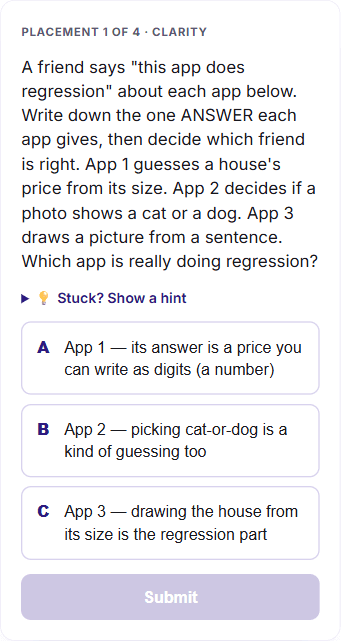
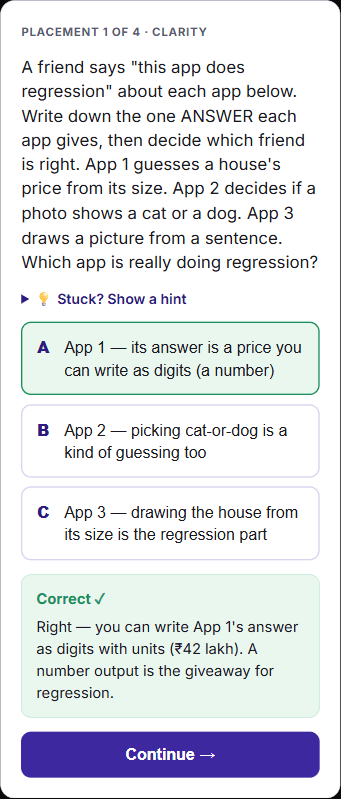
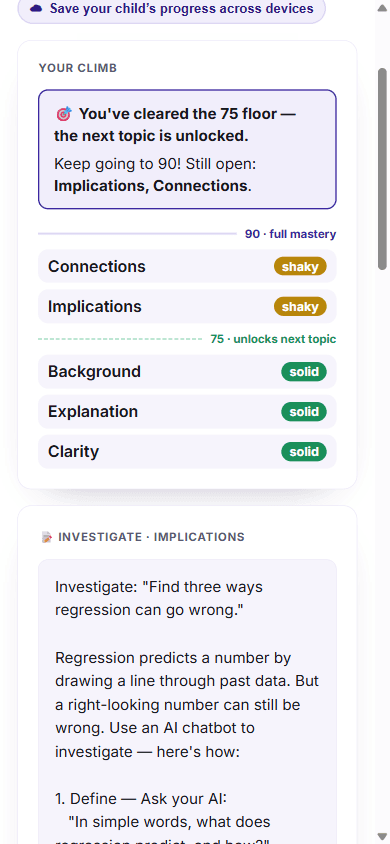
Three of these five are real screens from a live lesson — not mockups.
Here’s what it actually feels like, start to finish.
1. Pick a topic — free, nothing to install. 2. MILE asks you a few questions, to see where you already are. 3. It teaches the first idea you’re missing, in plain words, at your level. 4. You answer a real question, graded on the spot. 5. Clicked? Move ahead. If not, MILE comes at it another way.
Repeat it, and a syllabus that looked like a wall becomes a line of small ideas — each one checked, each one yours.
How it works · 01
Material that fits you
Grade 7 — written for
4
5
6
7
8
9
Measured: 6.49
Measured, not guessed: the Grade 7 AI course reads at grade 6.49 — one notch below the class it’s written for, on purpose.
Every subject is broken into the actual ideas people get stuck on, each written at a reading level we measure, not guess. Our Grade 7 AI course, for instance, measures a notch below the class it’s written for — so the words stay out of the way of the ideas. And because it all comes from one source, the same course is built to run in English and Hindi side by side — English is live today, Hindi is next, so the language you learn in will be a choice, not a compromise.
How it works · 01
What that looks like, taught
45s
A real lesson from the material Manthika teaches with — the water cycle, explained stage by stage, then the whole chain again. Proof, not a promise.
How it works · 02
A guide that stays with you
a topic
Checks where you standa few quick questions, before any teaching
Teaches the one idea you're missingnot the next item in a fixed list
Asks a real questionauto-graded on the spot
clicked?not yet — it comes at it another wayyesyesthe next idea
not yet — it comes at it another way
The loop a good teacher runs by hand: find the gap, teach it, check it honestly — and never move on until it clicks.
MILE — think of it as a patient tutor inside the lesson. It checks what you already know, then uses your answers to decide what to teach next: the idea you’re actually missing, not just the next item on a fixed list. If an explanation doesn’t land, it comes at it another way. It won’t rush you, and it won’t march you through what you already know.
How it works · 03
An honest check at every step
Every idea comes with real, auto-graded questions — the kind that show whether something clicked, or only felt familiar. Not to judge you: your answers tell MILE what’s next, and they tell you where you stand. You never close a topic just hoping. You know — and so does the guide planning your next step.
Look inside
AI & Computational Thinking — Data Literacy
Reading Data Honestly: the accuracy test
A model can score 95% and still be the wrong model to trust. Here’s an actual page from one of our books — the same honesty this whole feed runs on.
Two full courses are already live — AI & Computational Thinking for Grade 7, and Class 11 Physics, with a real teaching loop on Work, Energy & Power. Eight more subjects are loaded as one-topic samples, a taste of what’s on the way. All of it free to try, right now.
Where to begin
Different goals, different doors
CBSE parents — India’s national school board — get class-by-class books and the marksheet story. Aspirants get the same method pointed at UPSC, India’s civil-services exam, built for grown-up answer-writing. And ManthikaOS — the study-skills layer under every subject — teaches how to study and how to reason, in any language, any country. Same method, different doors.
Loading more…
Manthika Feed · v2 · the tour and a sample, no infinite scroll