How to Study
This book is for you if you are studying anything at all.
The book is in preparation, as of September 2026.Who it is for
This book is for you if you are studying anything at all. School, college, an entrance or job exam, a professional certification, a language, or a skill for its own sake — all count, and you can be fifteen or older, with no upper age. It is written at a Class 10 reading level — not your age — so you can read it alone if English is your second language. The reader it has most in mind studies in a small town, on broken time, with a shared phone.
The problem it answers
You are told to study, but almost nobody teaches you how. The methods most people fall back on — reading the chapter again, highlighting, copying out notes — feel like work. They build very little, because they make a page look familiar without making you able to produce what is on it. You put in the hours. The hours do not stick, and you conclude the fault is in you. It is in the method.
What changes for the reader
Work through this book, and you study differently afterwards. You do different things at the desk — you do not just know more words about studying. Every method in the book is one you perform on your own material before moving on. The book asks you to test each one on yourself rather than take it on trust. It makes no promise about marks.
What is inside
The methods, one tool at a time.
You learn to read so that it lodges, to recall from memory instead of re-reading, and to space your returns. You explain things in your own words, and work examples before letting them go. Then comes getting yourself to do the work, and checking that it is holding. The book also sorts what deserves learning by heart from what must be understood. It shows that traditional Indian methods, such as reciting with the page closed, already do the right thing on the right material.
A plan for exactly where you are.
You place yourself with two numbers: how much time is left — tonight, one week, one month, a season — and what result you want, from a pass to the top. Each plan is one or two pages and points back to the methods it runs on. There is also a plan for the reader with no exam and no date.
Every exam shape, and how to meet it.
Exams come in six shapes — the descriptive paper, the multiple-choice paper under time with a penalty for wrong answers, the speed paper, the long written answer, aptitude and language, and the interview. One short chapter covers each of more than forty exams, from school boards to job exams, naming which shapes it uses. A dated box flags anything that changes yearly.
Why the methods work, for the curious.
A short appendix holds a handful of models of how learning happens. Among them: the difference between recognising something and understanding it, how forgetting runs over time, and how little the mind can hold at once. Each model is also introduced in the main text where you first need it, so you can decide for yourself in a situation the book never scripted.
What a page looks like
The printed book is a 6 by 9 inch paperback. Each tool gets six pages laid out as three spreads. The first shows what the tool is and why it works, with a drawing of the mechanism. The second shows the weak way and the strong way side by side, then a drill to run now. The third is a repetition on your own material, and the two doubts most readers have, each answered. Every spread carries drawings; the weak method is always drawn in red.
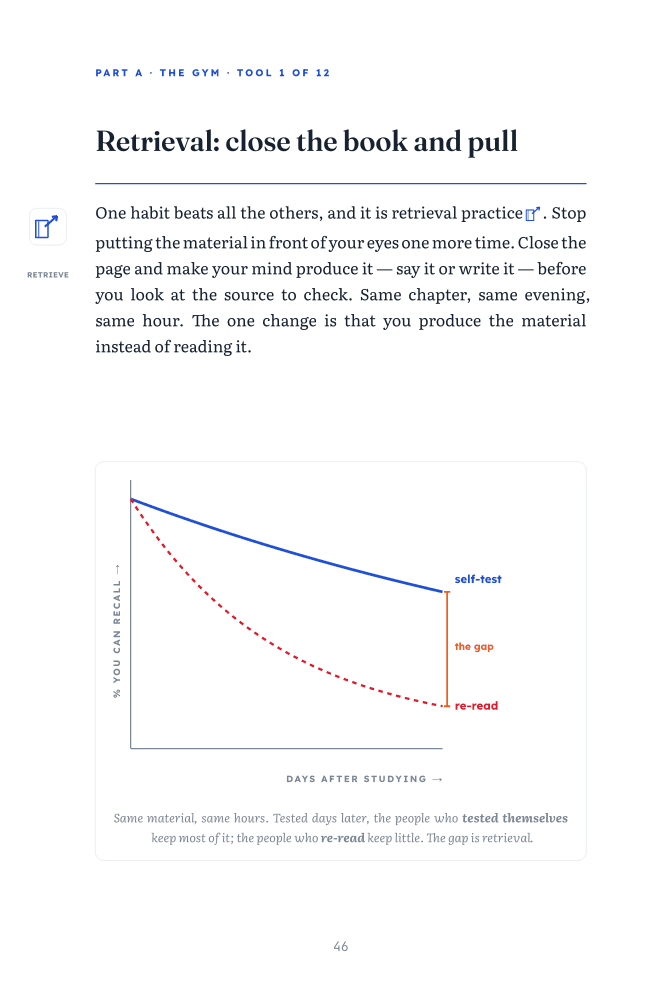
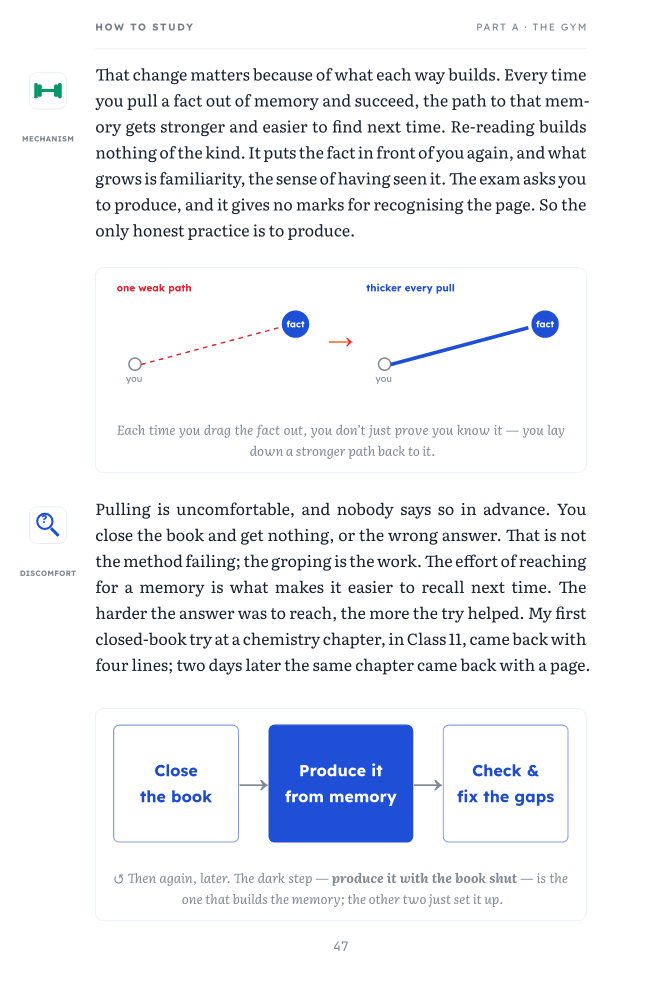
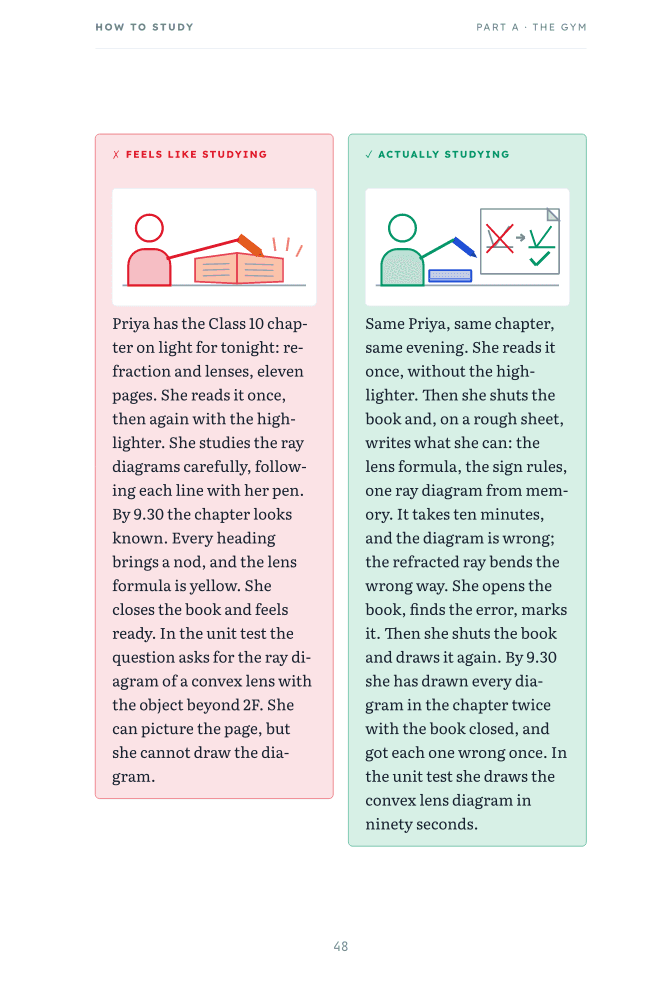
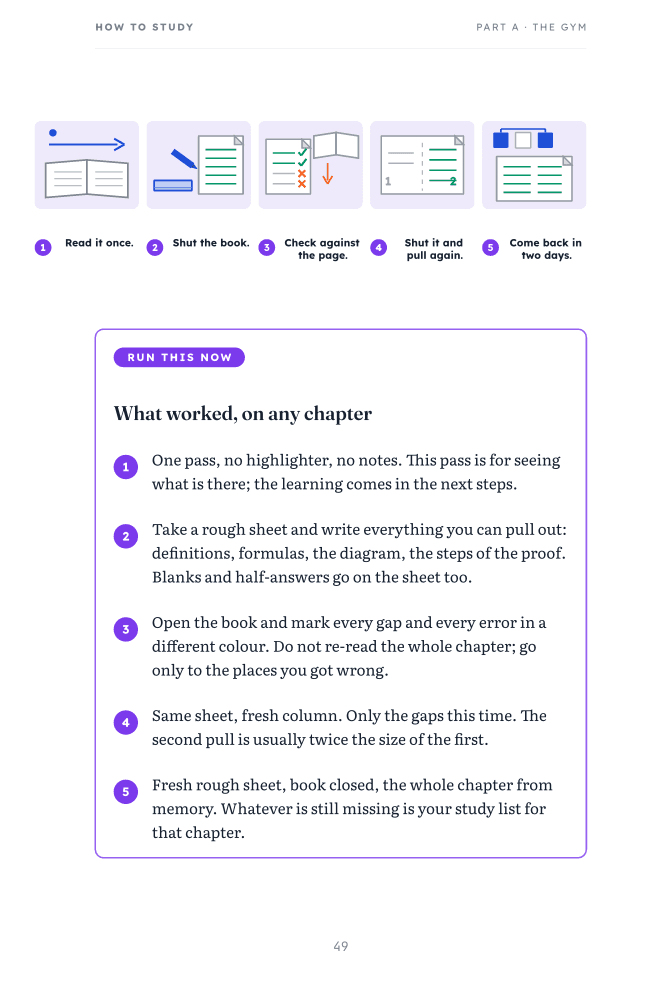
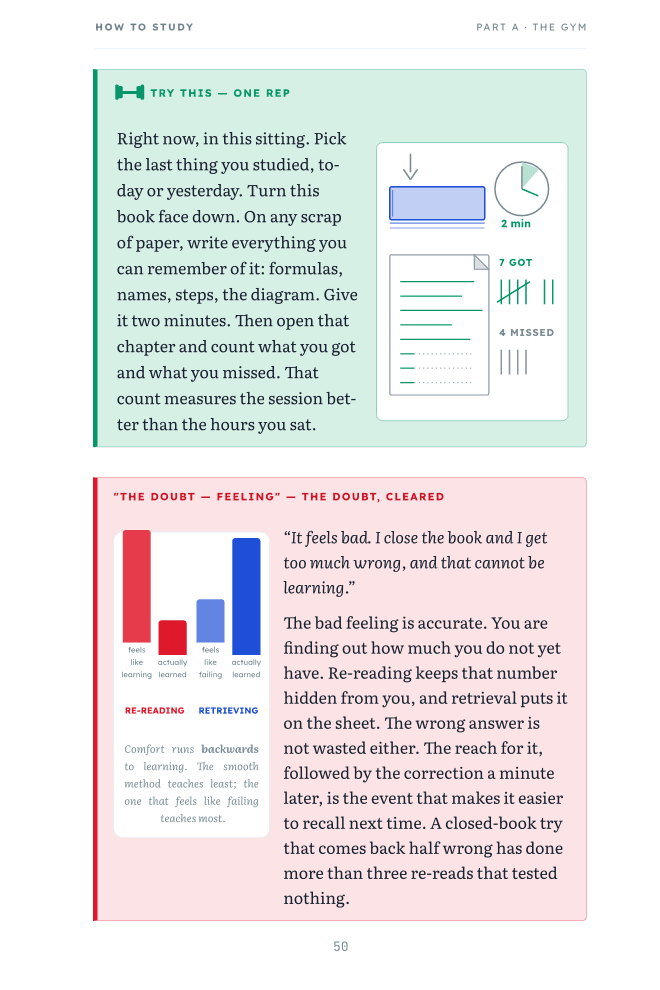
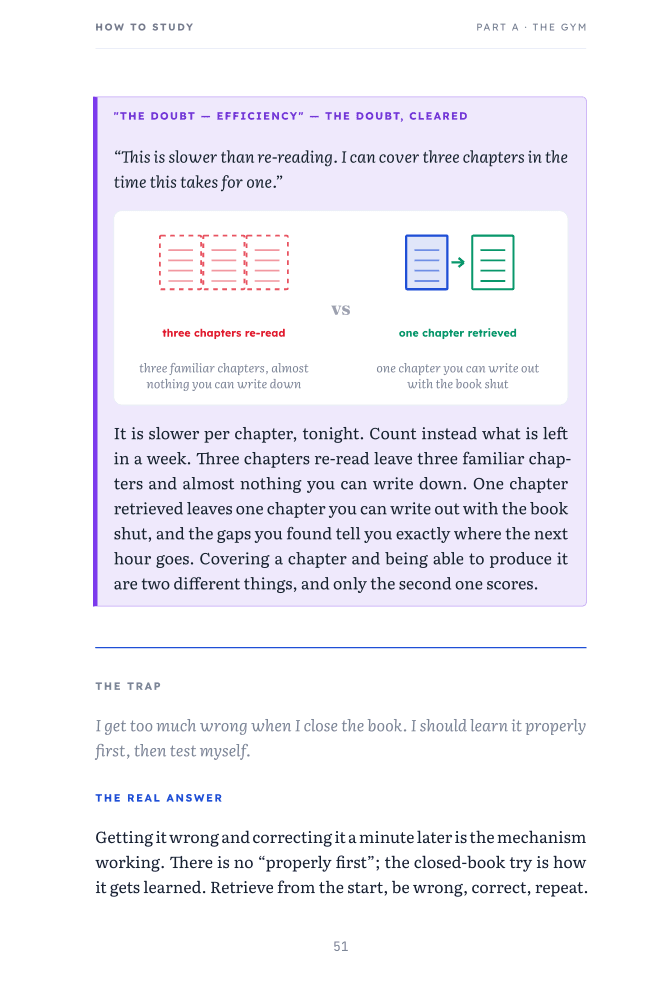
Sample pages. The design may change before release.
What it is not
This is not a book for one exam or one board. It is not tied to the CBSE curriculum or to any other board, and it is not a translation into Hindi or another language. It does not teach speed-reading or memory tricks that claim to skip the work. It carries no practice question bank and no answer keys.
Where the book stands today
Status as of 19 September 2026. The book is in preparation, as of September 2026. One chapter, Reading to learn, is free to read on the Manthika site right now. No release date and no price have been set yet.