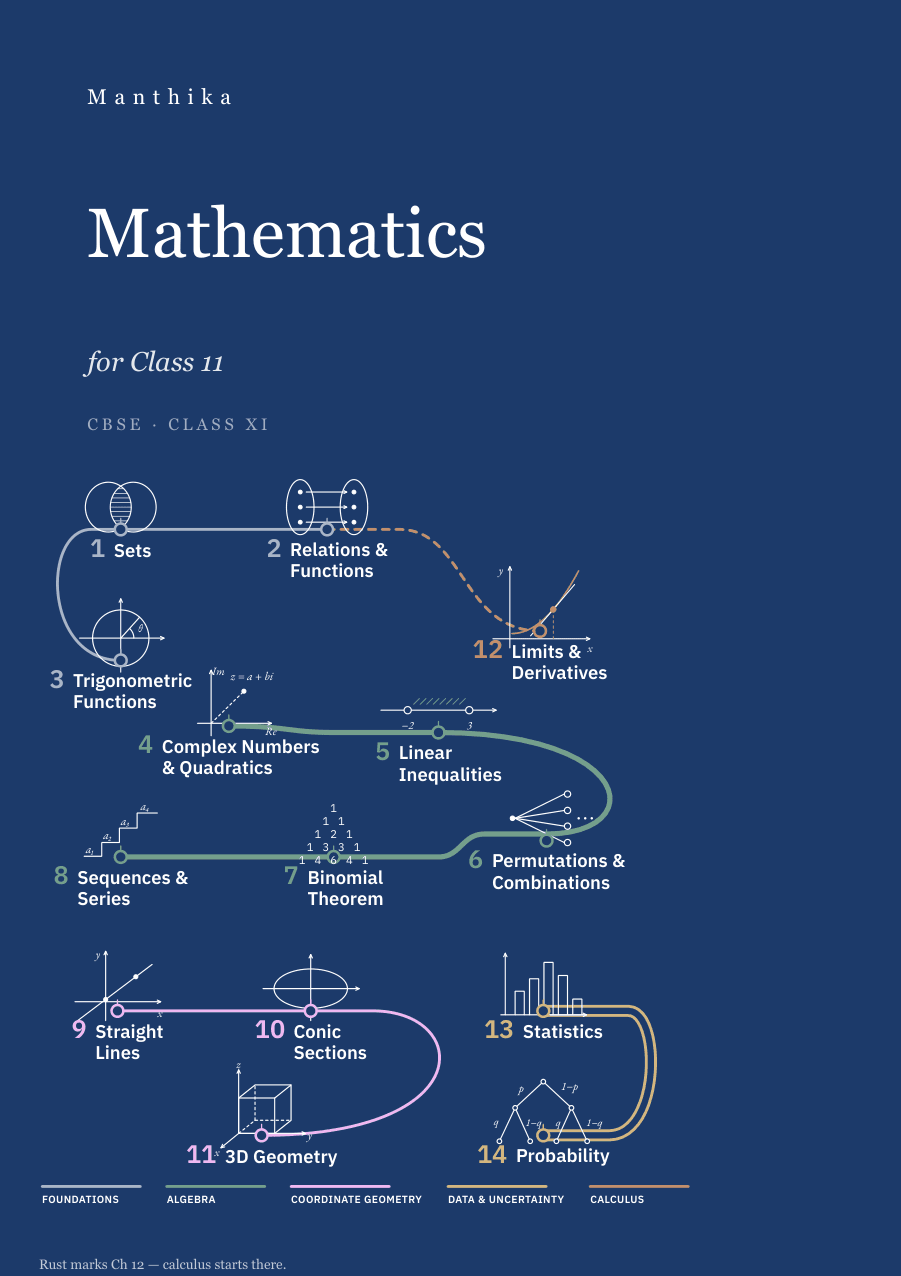
Mathematics · Class 11
Manthika Mathematics · Class 11 · CBSE
All 14 chapters on the siteThe promise
A Class 11 or 12 student with no coaching class can learn every syllabus topic from this book alone, well enough for the board exam and for the JEE or NEET questions built on it.
That means the explaining is done here, on the page. Each chapter opens where you are, builds the idea step by step, and shows worked examples before it sets you a problem. Every printed problem is solved in the back, step by step, with the reason beside each step. No teacher, no tuition class and no second book is assumed anywhere in it.
Mathematics, Class 11, on the 2026–27 CBSE syllabus.
Topic list & syllabus map
Sets
- representations
- empty set
- finite/infinite
- equal sets
- subsets
- subsets of R especially intervals (with notation)
- universal set
- Venn diagrams
- union
- intersection
- difference
- complement
- properties of complement
Relations & Functions
- ordered pairs
- Cartesian product of sets
- number of elements in the Cartesian product of two finite sets
- Cartesian product of R with itself (up to R×R×R)
- definition of relation
- pictorial diagrams
- domain/co-domain/range of a relation
- function as a special type of relation
- pictorial representation of a function
- domain/co-domain/range of a function
- real-valued functions — constant
- identity
- polynomial
- rational
- modulus
- signum
- exponential
- logarithmic
- greatest-integer functions with their graphs
- sum/difference/product/quotient of functions
Trigonometric Functions
- positive/negative angles
- radian/degree conversion
- definition via unit circle
- sin²x+cos²x=1
- signs by quadrant
- domain and range of trigonometric functions and their graphs
- expressing sin(x±y) and cos(x±y) and their simple applications
- deducing identities: tan(x±y)
- cot(x±y)
- sum-to-product identities (sinα±sinβ, cosα+cosβ, cosα−cosβ)
- identities for sin2x/cos2x/tan2x and sin3x/cos3x/tan3x
Complex Numbers & Quadratics
- need for complex numbers (motivated by inability to solve some quadratics)
- algebraic properties of complex numbers
- Argand plane
Linear Inequalities
- linear inequalities
- algebraic solutions of linear inequalities in one variable and their representation on the number line
Permutations & Combinations
- fundamental principle of counting
- factorial n
- permutations and combinations
- derivation of formulae for ⁿPᵣ
- ⁿCᵣ and their connections
- simple applications
Binomial Theorem
- historical perspective
- statement and proof of the binomial theorem for positive integral indices
- Pascal's triangle
- simple applications
Sequences & Series
- sequence and series
- Arithmetic Mean (A.M.)
- Geometric Progression (G.P.) — general term
- sum of n terms
- infinite G.P. and its sum
- Geometric Mean (G.M.)
- relation between A.M. and G.M
Straight Lines
- brief recall of 2D geometry
- slope of a line and angle between two lines
- forms of the equation of a line — parallel to axis
- point-slope
- slope-intercept
- two-point
- intercept — distance of a point from a line. No "family of lines through the intersection of two lines."
Conic Sections
- sections of a cone — circles
- ellipse
- parabola
- hyperbola
- a point
- a straight line
- a pair of intersecting lines as degenerate cases — standard equations and simple properties of parabola/ellipse/hyperbola
- standard equation of a circle
Intro to 3D Geometry
- coordinate axes and coordinate planes in three dimensions
- coordinates of a point
- distance between two points. Nothing else — no direction cosines
- no vectors
- no lines/planes in 3D (those are Class XII)
Limits & Derivatives
- derivative introduced as rate of change (distance function and geometrically)
- intuitive idea of limit
- limits of polynomials/rational/trigonometric/exponential/logarithmic functions
- definition of derivative related to the slope of the tangent
- derivative of sum/difference/product/quotient of polynomial and trigonometric functions
Statistics
- Measures of Dispersion only — range
- mean deviation
- variance and standard deviation of ungrouped/grouped data. No mean/median/mode as new content (Class X review)
Probability
- events
- occurrence of events
- 'not'/'and'/'or' events
- exhaustive events
- mutually exclusive events
- axiomatic (set-theoretic) probability
- probability of an event and of 'not'/'and'/'or' events. No conditional probability
- no Bayes' theorem (Class XII)
What it is — and isn't
It follows the CBSE Mathematics syllabus for 2026–27 chapter by chapter, in NCERT's order. Each chapter teaches its idea from the beginning, shows worked examples before it sets a problem, names the mistakes students actually make. Every printed problem is solved in the back, step by step with the reason beside each step, next to a glossary and the reference pages the subject needs.
What it is not: an NCERT solutions book — it solves its own problems only; a sample-paper or previous-year-paper bank; a coaching module or test series; a CBSE or NCERT publication; the school — no lab work, projects or internal-assessment help. Nor is it a JEE Advanced or NEET-level problem book — the ceiling is NCERT plus the entrance-exam application tier — a formula-sheet crammer, or a bridge course from the previous class beyond its assumed-skills page.
Read a chapter, free
Free to read: these chapters open in any browser, with no account.