 Why this book exists
Ideas that decide life go mostly untested.
If you are the child this book is for, you can skip these two pages. The page after them is yours. These two are for whoever else wants to know why the book was made.
The list of subjects a school teaches was settled more than a hundred years ago. In 1892 a committee of ten American educators met to decide what a school should teach, and the schools of British India were built on a similar plan around the same time. The list was made to answer one question: what will the university examine? What sits inside each subject has been revised many times since. The list itself has never been reopened.
So school, as it stands, prepares for college. But most of a life is not spent in college, and the ideas that decide how a life goes are mostly not on any paper a student will sit. Whether school does its one job well is argued about. That it does no other job is not.
There are two ways to make school more useful. One is to add what jobs need: accounts, a spreadsheet, a letter that gets answered. The larger change is to add what living needs. How to tell luck from skill in a result. How to know whose side an adviser is on. What a cost already paid should and should not decide. How to turn a wish into a plan that actually happens. These ideas decide more of a life than any subject on the timetable, and no timetable carries them.
Almost every idea in this book was worked out in the last hundred years, most of them after 1940. They are in daily use in medicine, in courts, in engineering and in economics, and the people who use them mostly learned them at work, in their thirties, by getting something wrong first. The one place they did go is the adult shelf. Bookshops sell them, thinned down, to people who have already paid for not having them.
We think an eleven-year-old can hold most of these ideas, if the situation comes before the name and the words are the child’s own. That is the bet this book makes.
How the syllabus was made. We did not start from the subjects. We started from nineteen fields that adults work in, among them law, medicine, economics, engineering and psychology, and wrote down the ideas each uses daily. An idea that turned up in three or more fields under different names we called a deep model; seventeen survived that test. The rest are tools that belong to one field and that everyone should still have.
To earn a place, an idea had to pass four tests. It must matter often, or rarely but decisively; a child needs to know that drowning is silent perhaps once, and once is enough. Living must not teach it by itself; a person can be cheated many times and learn only suspicion, never the shape of the trap. It must replace a wrong belief that people actually hold. And school must not already teach it well; we checked each idea against the board syllabus.
Every idea carries its evidence: tested in trials, seen again and again in records, true by how it is defined, or resting on a documented case. Every instruction a child might act on was checked against a source, not against whether it sounded right. Four that sounded right were false as stated, and were fixed or removed.
Then each idea was placed in the year its situation first arrives. At eleven the situations are marks, fairness among friends, the home and the body. At twelve the phone arrives, and the first money. At thirteen the household’s health decisions. At fourteen the choice of stream. At fifteen the board year. At sixteen the first contract a person can sign. At seventeen the vote and the first job. Twenty-one come back two or three classes later in a harder form, and in the last two books five of those returns are worked through as arithmetic.
Before a word of the chapters was written, the list and its order were given to five separate reviewers with one instruction: break it. They found the order wrong in six places, five claims drifted from their sources, and the returns badly spaced. Each was fixed. What you hold is the version that survived.
This book makes no promise about marks. It promises that a child who finishes it will see, in a new situation, the idea inside it, and will know how sure to be. That is what the adult shelf sells. We would rather it were ordinary.
Manthika, 2026
Each idea lands in the right year.
21 return two or three classes later in a harder form; 5 come back a third time, worked with numbers.
A row is a class and its book. A column is one of the five units: what people do, what chance does, how systems behave, the self, and the future. The number is how many chapters that book gives the unit.
| Book | People | Chance | Systems | Self | Future | All |
|---|---|---|---|---|---|---|
| Class 6 · age 11 | 4 | 1 | 4 | 4 | 5 | 18 |
| Class 7 · age 12 | 4 | 3 | 4 | 6 | 3 | 20 |
| Class 8 · age 13 | 5 | 7 | 5 | 6 | 2 | 25 |
| Class 9 · age 14 | 6 | 3 | 3 | 4 | 5 | 21 |
| Class 10 · age 15 | 3 | 8 | 2 | 1 | 5 | 19 |
| Class 11 · age 16 | 4 | 2 | 5 | – | 2 | 13 |
| Class 12 · age 17 | 2 | 4 | 2 | – | 3 | 11 |
Class 6 · 18 chapters · written
- The bad test after the great one · Regression to the meanChance
- Who cuts the cake · Procedure as fairnessPeople
- Who chooses first · Cut-and-choosePeople
- The Hour You Didn’t Pick · Trade-offs / opportunity costFuture
- The window seat · Different valuationsPeople
- Whose Side Are They On · Incentives / whose agentPeople
- Exactly enough time · Margin of safetySystems
- The fever came down · Symptom vs causeSystems
- The fright before the poem · Emotions are signalsSelf
- The phones that went into socks · Second-order effectsSystems
- One stove, four dishes · BottleneckSystems
- The loud part · ORS logicSelf
- Nobody shouted · Drowning is silentSelf
- The dry one · Heat illnessSelf
- Forty minutes in · Sunk costFuture
- The timetable on the board · The circle of actionFuture
- The wish list · Wish vs wantFuture
- When the plates are cleared · If-then plansFuture
Class 7 · 20 chapters · written
- Just one more · Evolutionary mismatchSelf
- Nothing, then everything · Exponential vs linearSystems
- The ones who are not there · Selection effectsChance
- The ones that travel · Virality selects for outrageSystems
- What the map leaves out · The map is not the territoryChance
- Two ways to say it · FramingPeople
- How it really happened · Memory is reconstructiveSelf
- What the head puts in · Perception is inferenceSelf
- Sideways, not down · Lateral readingChance
- The same water · Prisoner's dilemma / commonsPeople
- Is carrom a sport? · Many arguments are about wordsPeople
- A key anyone can use · Security mindsetPeople
- Someone put it there · Everything man-made was decided by someoneSystems
- The door that says pull · AffordancesSystems
- Perfect at what? · SpecificitySelf
- What the rain did · Adaptation happens in recoverySelf
- The summer she grew · A growing skeletonSelf
- Hair grows back · ReversibilityFuture
- Future me will do it · Present biasFuture
- Out of reach · PrecommitmentFuture
Class 8 · 25 chapters · written
- The forward that arrived on a Tuesday · Burden of proofChance
- The test that said yes · Base ratesChance
- The match that fixed itself · Regression to the meanChancereturns, first met in Class 6
- The forward with no name · Sources have authorsChance
- The fix that didn’t catch up · Correction asymmetryChance
- The queue that stayed the same · What else must be trueChance
- The one thing they all needed · Correlated riskChance
- No fix, no fee · Incentives / whose agentPeoplereturns, first met in Class 6
- The line under the name · Read the saltPeople
- Everywhere the blood goes · A drug is a moleculeSelf
- Sorted, not blamed · Side-effect classesSelf
- Not too little, not too much · Therapeutic windowSelf
- Three things, not one · Unlabeled + chronic + instantSelfrefreshes ORS logic
- It just hasn’t shown yet · Feedback loops with delaySystems
- Quiet is not proof · Symptom vs causeSystemsreturns, first met in Class 6
- Not every bad day is the same size · Margin of safetySystemsreturns, first met in Class 6
- Not the loudest, not the first · TriageSystems
- Test the middle · BisectionSystems
- A fair rule comes first · Procedure as fairnessPeoplereturns, first met in Class 6
- What you ask for, and why · Positions vs interestsPeople
- Say one name · Diffusion of responsibilityPeoplerefreshes Drowning is silent, Heat illness
- She said she was fine · A second knockSelf
- The bend the plan missed · IterationSelf
- Already filled in · Defaults decideFuture
- What you once wanted · Wants changeFuture
Class 9 · 21 chapters · written
- What it costs to undo · ReversibilityFuturereturns, first met in Class 7
- What choosing uses up · Trade-offs / opportunity costFuturereturns, first met in Class 6
- Keep the door, for now · OptionalityFuture
- Enough looking · Explore/exploitFuture
- How long it took last time · The planning fallacyFuture
- Everyone’s best move · Prisoner's dilemmaPeoplereturns, first met in Class 7
- The medicine that stops working · Antibiotic effectiveness is a commonsPeople
- The dose that isn’t only hers · Herd immunityPeople
- Exactly as it says · Letter vs spiritPeople
- The system answers back · Second-order effectsSystemsreturns, first met in Class 6
- Before you know your seat · Veil of ignorancePeople
- More votes, fewer seats · Election mechanicsPeople
- Two numbers, one thing · Every measurement has a ±Chance
- Close enough, or way off · Fermi estimationChance
- A frequency, not a promise · Probability-forecast literacyChance
- What the flow leaves behind · Stock vs flowSystems
- The slowest hand sets the pace · BottleneckSystemsreturns, first met in Class 6
- Topped up before it runs low · Half-lifeSelf
- The lock only the germ has · Selective toxicitySelf
- Four times, not twice · v²Self
- Stronger than anything it was built for · Evolutionary mismatchSelfreturns, first met in Class 7refreshes A growing skeleton, Security mindset
Class 10 · 19 chapters · written
- The stall nobody queued for · Expected valueFuture
- The joy that always comes home · Hedonic adaptationFuture
- Three months after the list went up · Impact biasFuture
- The bad news nobody had yet · PremortemFuture
- Ask again in three years · Wants changeFuturereturns, first met in Class 8
- The group that got quiet · Selection effectsChancereturns, first met in Class 7
- What a yes is worth · Base ratesChancereturns, first met in Class 8
- The drop nobody could tell apart · The RCTChance
- How strong the showing has to be · Burden of proofChancereturns, first met in Class 8
- What the shelf doesn’t say · The pharmacy shelfChance
- One shared line · Correlated riskChancereturns, first met in Class 8
- Money that wasn’t wasted · InsuranceChance
- The bend that crept up on him · Exponential vs linearSystemsreturns, first met in Class 7
- The note home and the group chat · The map is not the territoryChancereturns, first met in Class 7
- Nobody raised it on purpose · Prices are informationPeople
- It looked fine from here · Information asymmetryPeople
- Somewhere else to go · BATNAPeople
- Nothing, on purpose · Action biasSystems
- Pushing back · ToleranceSelfrefreshes Therapeutic window, Unlabeled + chronic + instant, A second knock, Diffusion of responsibility
Class 11 · 13 chapters · written
- The understanding nobody wrote down · The deal is the documentPeople
- Whose name is on the paper · Invisible liabilitiesFuture
- The price nobody paid · MSP is a price floorPeople
- The Saturday they split the chores · Comparative advantagePeople
- The hours nobody wanted to add · Prisoner's dilemmaPeoplethird time, first met in Class 7
- The one voice they kept quoting · Manufactured doubtChance
- The number the video left out · Conservation lawsChance
- The line that looked shortest · QueueingSystems
- The gate nobody could explain · Chesterton's fenceSystems
- The six days before the exam · Supply linesSystems
- Too hot, then too cold · Feedback loops with delaySystemsreturns, first met in Class 8
- The year it finally doubled · Exponential vs linearSystemsthird time, first met in Class 7
- How many times, before you believe it · The planning fallacyFuturereturns, first met in Class 9refreshes v²
Class 12 · 11 chapters · written
- The train that got smaller · Contingency & path dependenceFuture
- Two hundred replies · The circle of actionFuturereturns, first met in Class 6
- What guessing was really worth · Expected valueFuturethird time, first met in Class 10
- The smoke that crossed the lane · ExternalitiesPeople
- The price of the one that worked · The patent dealPeople
- The same line, five times · ChurnalismChance
- Three versions in an hour · Confidence tiersChance
- How rare, before the test · Base ratesChancethird time, first met in Class 8
- The chance they fail together · Correlated riskChancethird time, first met in Class 8
- The part with no backup · Single points of failureSystems
- The shop that did well · Profit ≠ cashSystemsrefreshes Invisible liabilities
The New Nuskas — Class 6
Out, free while readers review it. Opens with “The bad test after the great one”.
- Read “The bad test after the great one”, free → हिंदी
- Read “Who cuts the cake”, free → हिंदी
- Read “Who chooses first”, free → हिंदी
- Read “The Hour You Didn’t Pick”, free → हिंदी
- Read “The window seat”, free → हिंदी
- Read “Whose Side Are They On”, free → हिंदी
12 more chapters, free
- Read “Exactly enough time”, free → हिंदी
- Read “The fever came down”, free → हिंदी
- Read “The fright before the poem”, free → हिंदी
- Read “The phones that went into socks”, free → हिंदी
- Read “One stove, four dishes”, free → हिंदी
- Read “The loud part”, free → हिंदी
- Read “Nobody shouted”, free → हिंदी
- Read “The dry one”, free → हिंदी
- Read “Forty minutes in”, free → हिंदी
- Read “The timetable on the board”, free → हिंदी
- Read “The wish list”, free → हिंदी
- Read “When the plates are cleared”, free → हिंदी
The New Nuskas — Class 7
Written, being checked. Opens with “Just one more”.
- Read “Just one more”, free →
- Read “Nothing, then everything”, free →
- Read “The ones who are not there”, free →
- Read “The ones that travel”, free →
- Read “What the map leaves out”, free →
- Read “Two ways to say it”, free →
14 more chapters, free
- Read “How it really happened”, free →
- Read “What the head puts in”, free →
- Read “Sideways, not down”, free →
- Read “The same water”, free →
- Read “Is carrom a sport?”, free →
- Read “A key anyone can use”, free →
- Read “Someone put it there”, free →
- Read “The door that says pull”, free →
- Read “Perfect at what?”, free →
- Read “What the rain did”, free →
- Read “The summer she grew”, free →
- Read “Hair grows back”, free →
- Read “Future me will do it”, free →
- Read “Out of reach”, free →
The New Nuskas — Class 8
Written, being checked. Opens with “The forward that arrived on a Tuesday”.
The New Nuskas — Class 9
Written, being checked. Opens with “What it costs to undo”.
The New Nuskas — Class 10
Written, being checked. Opens with “The stall nobody queued for”.
The New Nuskas — Class 11
Written, being checked. Opens with “The understanding nobody wrote down”.
The New Nuskas — Class 12
Written, being checked. Opens with “The train that got smaller”.
Every book is written at its own class’s reading level, and none needs a chapter from another book. No release date and no price have been set. What the book is, with sample pages and the prospectus PDF →
Read one chapter at a sitting.
Read them in order. Look at the picture before you read the words.
One chapter at a sitting, in order. Each one takes about as long as a television episode. They are in the order they are in for a reason: a later chapter sometimes needs an earlier one, and none of them needs a chapter from another book.
Look at the picture before you read the words. Every chapter shows you the situation first and names it afterwards. If you look at the picture and guess what is going on before you read, the name will stick.
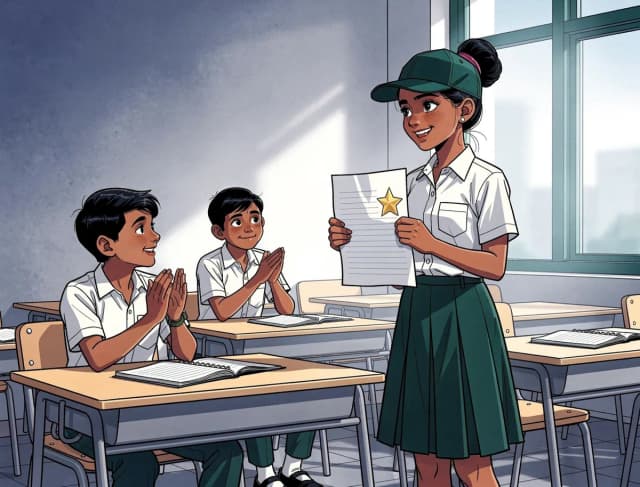 1. the situation
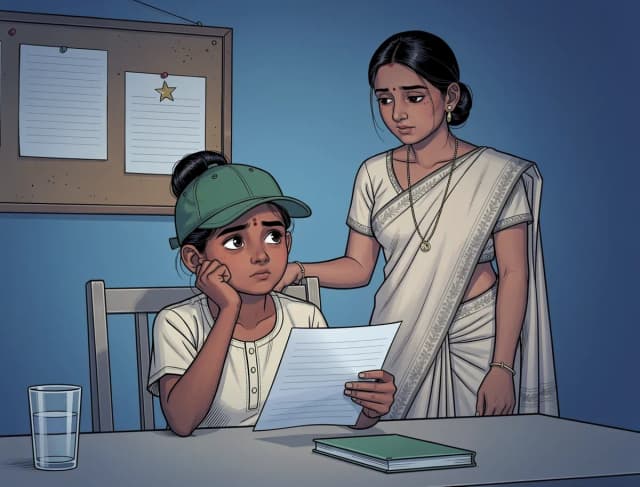 2. the name, after
Near the end of every chapter, one box asks you to do one thing this week. It is never homework and there is nothing to hand in. It is usually a question to ask someone older than you — not to catch them out, but because they will know something you do not.
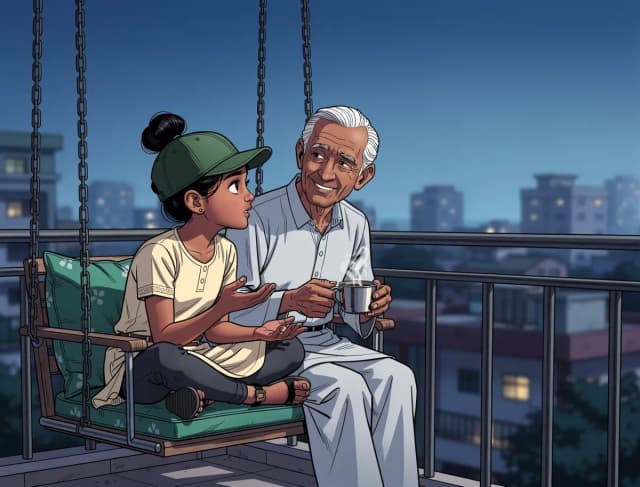
You will meet each of these ideas again. The last line of every chapter tells you where. Nothing here is finished this year.
How sure this book is. Some of these ideas were tested on real people. Some are seen again and again in records. Some are true just by their own definition, the way a rule is true once you agree what the words mean. One study this book could have used turned out to have bad data. The people who checked it pulled it. This book does not use it either. The last pages say which is which, and where each one comes from.
If you are the parent holding this book. You can check every idea in it. The last pages say where each one comes from and how sure we are. The one thing that helps is answering the question your child brings you at the end of a chapter, and answering it, including when the answer is that you do not know.